The Intelligent Clinical Backbone : How One of the Top 10 Hospital Groups in India Conquered Discharge Delays and the Bed Crunch
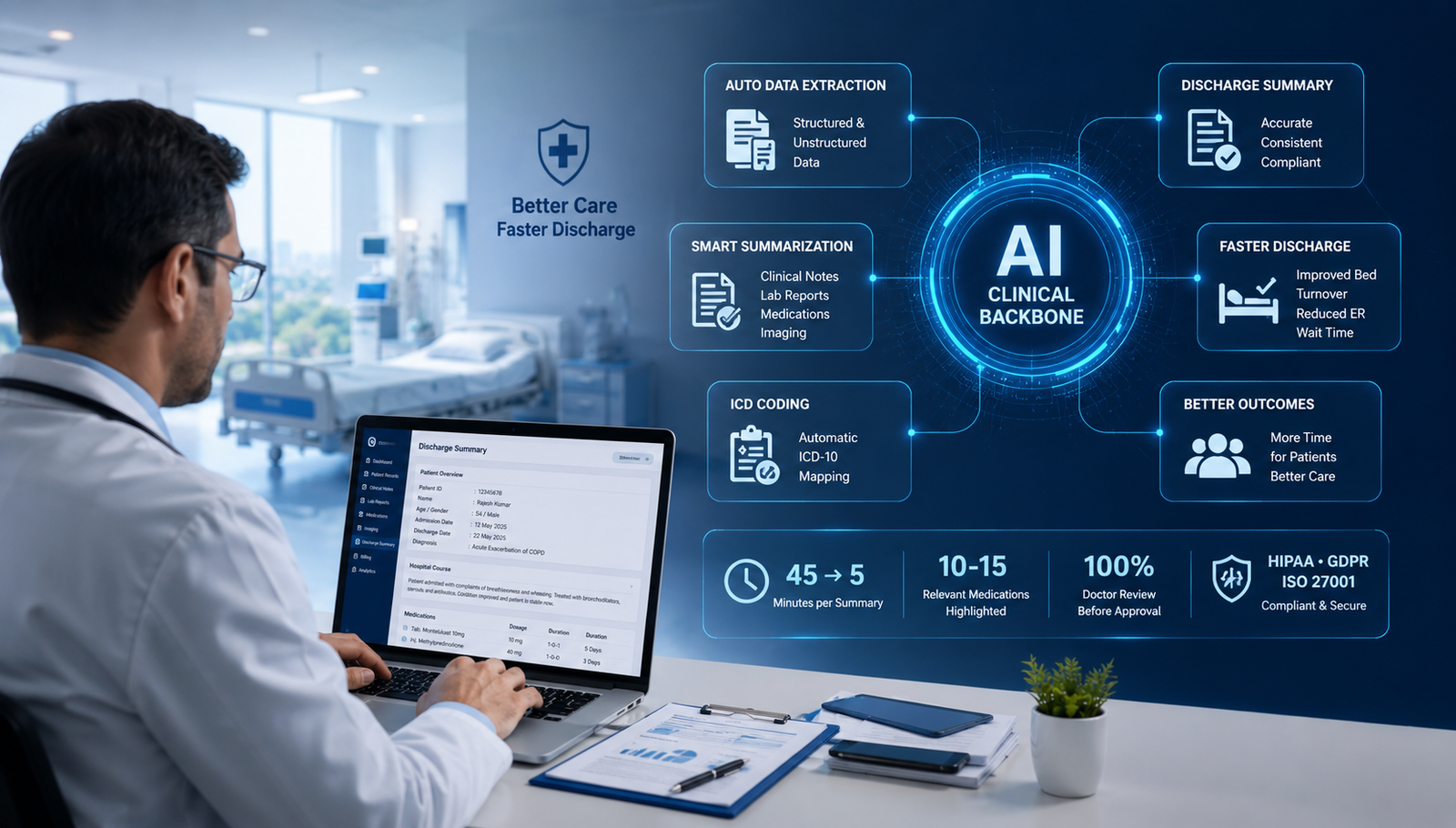
The Intelligent Clinical Backbone
For modern hospitals, storing patient data isn't the problem, but putting it together quickly is. One of the top 10 hospital groups in India recognized that its legacy HMIS workflows were causing severe clinical friction.
Client Hospital faced a critical issue: administrative paperwork was causing severe bed shortages. Patients who were medically cleared to go home were stuck waiting for their discharge summaries, which in turn left new emergency admissions stranded in the ER without a bed. By partnering with us, the client hospital group in India integrated an end-to-end, AI-powered API that acts as an intelligent clinical backbone.
Today, their discharge workflow is automated, highly contextual, and driven by a self-improving multi-agent AI system that reduces manual paperwork, drastically improves bed turnover, and lets doctors get back to what they do best: treating patients.
The Bed Crunch and the Charting Struggle
Before our AI solution, healthcare providers struggled with the same bottleneck that plagues many major healthcare groups. Pulling data from the patient’s file is the easy part. The real challenge was knowing what to do with it.
- The RMO Burden : Resident Medical Officers (RMOs) were exhausted, serving more as data-entry clerks than as doctors. They had to manually toggle among EMR tabs, lab reports, admission booklets, surgical notes, and daily progress sheets just to piece together a single summary.
- The Bed Crunch : Because writing these summaries took so long, beds remained occupied by discharged patients, directly causing backups in the ER.
- Information Overload : Legacy systems simply dumped a massive, unorganised list of every medication and test into the document. This buried the actual clinical story in noise.
Building the Bridge
Fixing a massive hospital's discharge process had to be done carefully to ensure clinical safety and efficiency
- Messy Data : Patient files were a chaotic mix of typed EMR data, raw database dumps, and handwritten clinical notes.
- Clinical Accuracy : In healthcare, AI cannot guess. The model had to be perfectly accurate without making up, or "hallucinating," information.
- Doctor Adoption : Doctors are protective of their routines. The system needed to help them work faster without replacing their medical authority.
A Phased, Multi-Agent Approach
Instead of forcing doctors to write from scratch, we deployed specialised, multi-agent AI that does the heavy lifting. The platform "talks" directly to the hospital’s existing HIMS via API, instantly fetching both structured data and messy, unstructured notes.
- Smart Structuring for Free Text: For complex sections like Presenting Complaints and Hospital Course, doctors no longer have to type perfect paragraphs. They simply input quick, rough notes. The AI instantly understands the context and rewrites the information into a well-formatted, professional structure.
- Automated ICD Coding: In the diagnosis section, the system automatically reads the doctor's notes and instantly fills in the most relevant and probable ICD codes.
- Targeted AI Agents: We used advanced OCR to cleanly read both printed and handwritten records across departments, pulling exactly what was needed without the clutter. It highlights only the top 10 to 15 most clinically relevant Medications and Investigations.
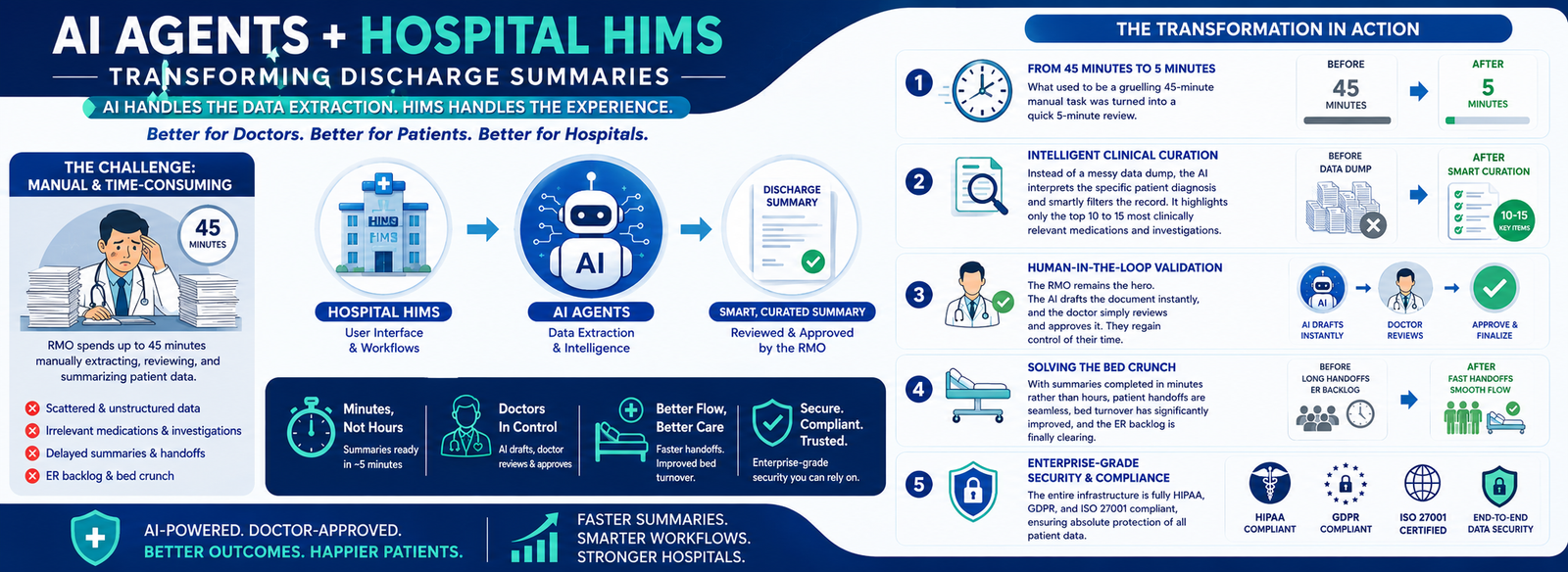
Faster Discharges, Better Care
By partnering with us, one of the top 10 hospital groups in India didn't just solve a paperwork problem. They eradicated information overload, reduced physician burnout, and elevated their HMIS from a basic data repository to a premium, enterprise-grade clinical intelligence tool.
- Elevating the Patient Experience : By eliminating discharge wait times, the system ensures patients are transitioned home quickly and seamlessly, significantly enhancing clinical care and service delivery.
